
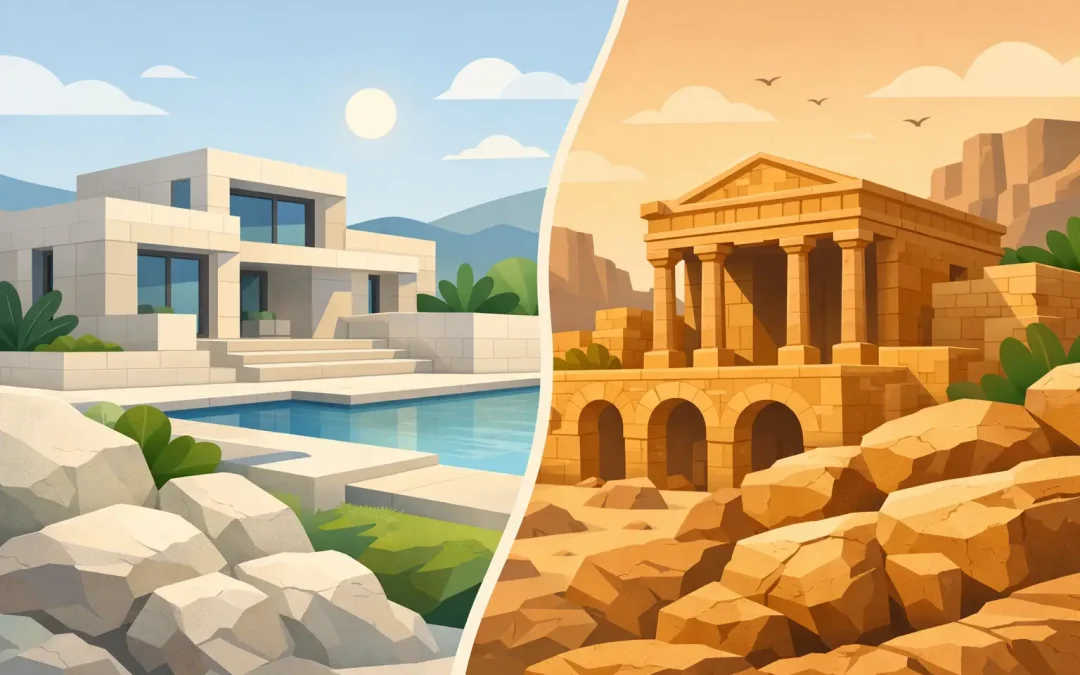
A stone sample can look persuasive under studio lighting, then behave very differently once it meets salt air, rainwater, pool splash, foot traffic and the hard Australian sun. That is why limestone versus sandstone is not simply a question of colour preference. It is a specification decision affecting the architecture’s character, detailing, maintenance strategy and long-term performance.
Both materials have earned a place in distinguished architecture. Sandstone is deeply familiar in Australian civic and domestic building, while limestone carries an equally compelling international legacy, from ancient construction to the defining streetscapes of Britain. The right choice depends on the intended expression of the project, the particular stone source and grade, and the conditions in which it will be installed.
Limestone Versus Sandstone: The Essential Difference
Limestone is a sedimentary stone formed principally from calcium carbonate, commonly originating from marine deposits. Its appearance is often calm and coherent: pale creams, warm whites, gentle greys and subtle fossil markings create a refined surface with visual depth but little visual noise. Portland Stone, the iconic British limestone seen on buildings including Buckingham Palace and St Paul’s Cathedral, is valued for precisely this measured architectural presence.
Sandstone is also sedimentary, but it is formed from compacted grains of sand, typically quartz and feldspar, bound by natural cement. Depending on its quarry, it may show pronounced bedding, iron-rich veining, granular texture and a broader range of buff, gold, brown, pink and grey tones. These characteristics can give sandstone a more visibly geological, earthy and textural quality.
This distinction matters at building scale. Limestone often reads as composed and monolithic, making it well suited to crisp contemporary forms, classical proportions and restrained material palettes. Sandstone can introduce movement and a stronger connection to landscape, particularly where a project calls for a tactile, layered or regional expression.
Neither description should be treated as a universal rule. Stone is not a manufactured product with a single, fixed appearance. Every quarry horizon, bed and block has its own mineral composition, porosity, strength, colour variation and working qualities. Samples, technical data and appropriately sized mock-ups remain essential before a final selection.
Appearance, Light and Architectural Character
The visual behaviour of stone changes through the day. Fine-grained limestone tends to reflect light softly, allowing façades and interiors to retain a sense of brightness without glare. Pale limestone can make deep reveals, colonnades, carved profiles and shadow lines especially legible. It is a material that rewards proportion and detail.
Portland Stone is particularly recognised for its consistent, light-toned character and ability to be cut into a broad range of architectural formats. Basebed, Grove Whitbed, Jordans Whitbed, Roach and Stonehills Whitbed offer related yet distinct expressions, from relatively clean and uniform selections to beds with more evident shell and fossil content. This enables designers to establish a disciplined material language while retaining the authenticity of natural stone.
Sandstone can be equally compelling, though its grain and banding often take a more active role. On large elevations, this may provide warmth and visual texture. It can also make jointing, orientation and the distribution of individual pieces more apparent. Where a minimal façade is the ambition, a highly variegated sandstone may compete with the geometry. Where a building is intended to feel embedded in a rugged setting, that same variation can be a strength.
For interiors, limestone is often selected for floors, wall linings, hearths and bathrooms where a quiet, enduring backdrop is preferred. Sandstone may suit spaces seeking a more rustic or textural finish, but its specific surface and porosity should be assessed carefully in wet areas.
Durability Is About the Stone and the Detail
It is tempting to ask which stone is tougher. The more useful question is: tougher against what? Compressive strength alone does not determine suitability. Exposure, salt crystallisation, freeze-thaw conditions where relevant, water management, surface finish, thickness, fixing method and maintenance all contribute to the outcome.
Some sandstones are exceptionally durable; others may be more susceptible to delamination along bedding planes or to surface change in severe exposure. Some limestones are dense and resilient, while more open-textured varieties need a specification suited to their characteristics. A reputable supplier should provide project-specific technical information rather than broad claims based solely on the stone category.
Water is central to the performance of both materials. Stonework should be designed to shed water rather than hold it. Correct drips, copings, flashings, falls, drainage cavities and joint design are not peripheral details: they protect the material and preserve the clarity of the architecture. On horizontal surfaces, finish selection should also respond to slip resistance, cleaning requirements and expected traffic.
In coastal Australia, airborne salts and repeated wetting and drying deserve particular attention. In urban settings, façade runoff, adjacent metalwork and poor drainage can cause staining or localised deterioration. A well-resolved system, tested where required, is more valuable than an assumed preference for one stone family over another.
Bedding Direction and Fabrication
Bedding direction is especially relevant to sandstone because its layers can be visually and structurally pronounced. Traditionally, stone is laid in its natural bed where possible, reflecting the way it was formed and helping manage loads and weathering. The appropriate orientation will depend on the application, stone type and engineering advice.
Limestone can also have bedding and must be fabricated with respect for its natural structure. This is particularly important for carved elements, load-bearing pieces, copings and bespoke profiles. Experienced stone manufacture combines modern precision with an understanding of how each block should be worked, oriented and finished.
Choosing for Façades, Paving and Detail
For a façade, the decision often begins with the desired architectural language. Limestone is a natural choice where the design calls for pale, elegant cladding with finely resolved edges, ashlar coursing, sculptural window surrounds or bespoke masonry. Its long association with civic, institutional and prestigious residential architecture gives it an established sense of permanence without relying on ornament.
Sandstone may be preferable for a façade intended to have a stronger local, earthy or stratified character. It can be highly effective on substantial walls, plinths and landscape-connected architecture, especially when its colour sits naturally within the site context. The designer should consider how variation across multiple palettes will read over an entire elevation, not simply in a hand sample.
For paving, surface texture, thickness, water movement and use patterns deserve as much attention as colour. Limestone paving can create sophisticated terraces, courtyards and pool surrounds when a suitable finish and appropriate stone grade are selected. Sandstone paving offers a familiar, tactile outdoor character and can work beautifully in gardens and informal entertaining areas. In either case, specify for the actual environment: a sheltered courtyard, a busy hospitality terrace and an exposed coastal pool deck present different demands.
Bespoke detailing can alter the equation. Limestone’s fine, workable character has made it a favoured material for mouldings, capitals, fireplace surrounds, stair components, carved signage and complex façade features. Sandstone can also be carved, although its grain and the chosen quarry material will influence the sharpness and delicacy of the result. If carved work is central to the scheme, engage stone specialists early, before profiles become fixed in the documentation.
Cost, Availability and Whole-of-Project Value
Initial material cost is only one part of a natural stone decision. Freight, lead times, format optimisation, cutting yield, fabrication complexity, testing, installation methodology and wastage all shape the project budget. A stone that appears economical per square metre may require greater allowance for sorting, sealing, thicker units or specialised installation.
There is also value in provenance and consistency of supply. For ambitious projects, access to a recognised quarry and an established manufacturing partner can reduce uncertainty around matching, replacement material and technical support. London Stone Co provides exclusive Australian access to British Portland Stone from Albion Stone, a fourth-generation family business with advanced manufacturing capability and a record of recognised natural stone awards.
This does not mean imported limestone is automatically the answer. A local sandstone may be the more appropriate material when regional continuity, site character or a particular colour palette is fundamental to the brief. The strongest specifications begin with architectural intent, then test the material against performance, fabrication and procurement realities.
Questions to Resolve Before Specifying
Ask to see samples that represent the expected range, not only the most uniform piece. Review the proposed finish in the same orientation and lighting in which it will be used. Confirm the stone’s intended application, thickness, fixing system and movement joints with the relevant consultants.
For external work, establish how water will leave the assembly and whether nearby materials could stain the stone. For interiors, consider cleaning products, food and wine exposure, underfloor heating, and the desired patina. Natural stone develops character over time; the aim is not to prevent every mark, but to select a material and finish whose ageing is compatible with the project’s expectations.
The most successful choice is the one that feels inevitable in its setting, performs confidently in service and gives the architecture greater presence with every year. Start with the building’s intended character, then allow the geology, craft and detail of the stone to guide the final specification.
Recent Comments