
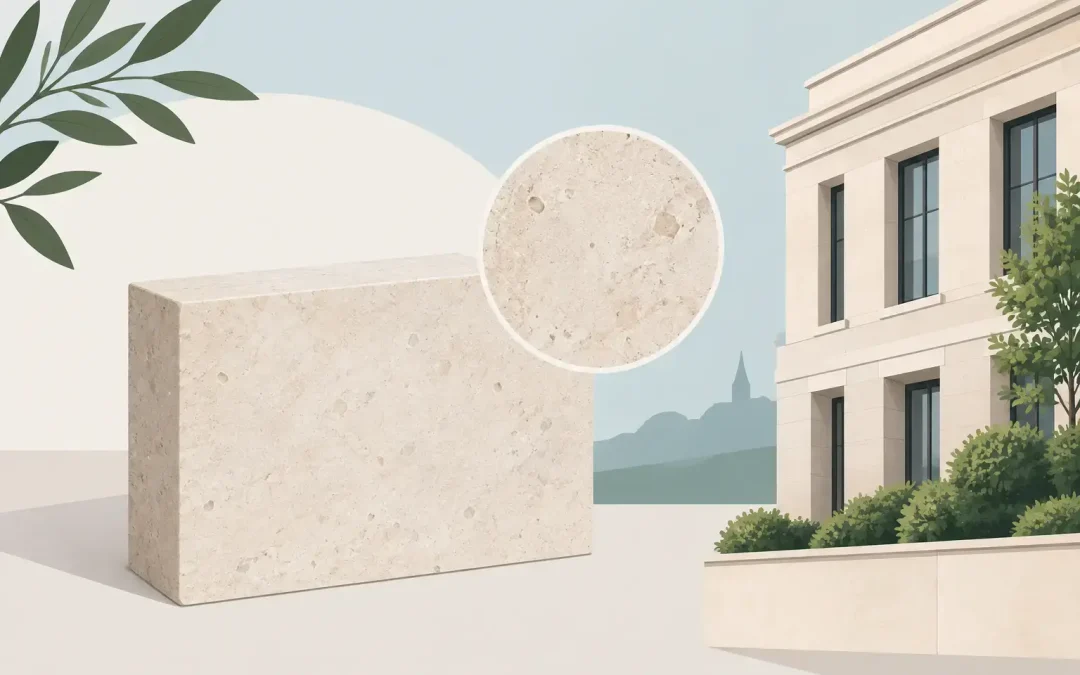
For project teams asking what is Grove Whitbed, the short answer is that it is a distinguished variety of Portland Stone: a pale, fine-grained British limestone valued for its calm appearance, workability and architectural pedigree. It is specified where a project requires more than a pale stone surface – where the material must also carry permanence, provenance and a disciplined visual character.
Grove Whitbed belongs to the Portland Stone family quarried on the Isle of Portland in Dorset, England. This iconic British limestone has shaped some of Britain’s most recognisable civic and cultural architecture, including St Paul’s Cathedral and Buckingham Palace. Grove Whitbed brings that lineage into contemporary façades, interiors, landscape schemes and bespoke stonework with a refined, considered expression.
What is Grove Whitbed Portland Stone?
Grove Whitbed is a natural limestone selected from a recognised Portland Stone bed. Its appearance is generally light and creamy, with subtle variations in tone and a fine-grained character that reads as composed rather than busy. As with all genuine natural stone, each block has its own mineral character, fossil content and tonal movement. That variation is not a defect to be designed out; it is part of the material’s authenticity.
The name matters because Portland Stone is not one uniform product. It describes a geological family with several distinct beds, each offering different visual qualities and practical possibilities. Grove Whitbed is appreciated by architects and designers seeking a relatively clean, light limestone that can support precise contemporary detailing while remaining connected to a long-established architectural tradition.
Its restrained colour allows it to work across many palettes. It can soften dark metalwork and glazing in a commercial façade, bring depth to quiet plaster and timber interiors, or give a landscape setting an established, civic quality. In bright Australian light, the stone’s pale surface can appear particularly luminous, though sample review remains essential because orientation, shadow and adjacent materials all affect how natural limestone is perceived.
The visual character of Grove Whitbed
The appeal of Grove Whitbed lies in its balance. It has sufficient natural interest to avoid the flatness of an engineered finish, but it is not typically chosen for dramatic shell content or overtly rugged texture. Its fine-grained appearance supports broad planes of cladding, carefully proportioned ashlar and finely resolved architectural details without competing with the overall composition.
This makes it especially effective when the design intent calls for visual continuity. A building envelope can read as a unified stone composition rather than a collection of individual panels. Interior wall linings, fireplace surrounds, stair components and joinery-adjacent details can take on the same sense of material coherence.
Finish selection changes the effect considerably. A sawn or honed surface presents the stone with crisp restraint and is often suited to interiors or protected applications. Textured finishes can give external elevations and paving more tactile presence, while carved or hand-finished work introduces shadow, depth and a more explicitly crafted character. The appropriate finish depends on the project’s intended use, slip requirements, exposure and maintenance expectations, not appearance alone.
Natural variation is part of the specification
No two beds of natural limestone are identical, and no quarry can promise a perfectly uniform appearance across every block. Grove Whitbed should be specified with a clear understanding that samples are indicative, not a complete map of the finished installation. Block selection, cutting direction, finish, jointing and the distribution of pieces across an elevation all influence the final result.
For sizeable schemes, it is prudent to discuss the desired visual range early. A project may favour a quieter selection for a formal façade, for example, while accepting a broader expression in landscape paving or secondary areas. This early conversation enables quarry supply, fabrication and stone allocation to be aligned with the architect’s intent.
Where Grove Whitbed is used
Grove Whitbed is a versatile architectural limestone, but versatility does not mean every use should be treated the same. Its greatest strength is its ability to move from large-format architectural surfaces to close-up crafted elements while maintaining a coherent material language.
For exterior applications, it may be used in dimensional walling, rainscreen cladding, traditional masonry façades, entrance portals, window surrounds, copings and architectural features. Its pale tone gives depth to shadow joints and reveals, allowing proportion and relief to do much of the visual work. On a prestige residence, the stone can create a quiet, enduring exterior that sits confidently alongside bronze, steel, oak or dark-framed glazing. On hospitality or institutional projects, it can establish a sense of permanence from the point of arrival.
Indoors, Grove Whitbed is particularly suited to wall linings, fireplaces, reception desks, stair details, floor finishes and bespoke carved features. Here, the tactile quality of real limestone becomes more apparent. Fine surface variation catches changing daylight, while the density and depth of the stone offer a materially richer alternative to imitation finishes.
Landscape use requires a more project-specific assessment. Portland Stone can be fabricated for paving, steps, pool surrounds, retaining elements and garden architecture, but finish, drainage, loading, slip resistance and local environmental conditions must be resolved properly. A lightly trafficked courtyard has different requirements from a public threshold or coastal pool terrace. The right stone finish and detailing are as important as the stone choice itself.
Why provenance matters to a stone specification
A limestone façade may look simple once complete, but its success depends on decisions made long before installation. Provenance affects consistency of supply, technical knowledge, manufacturing capability and confidence in the material’s long-term suitability. For Grove Whitbed, the quarry source and the expertise behind block extraction and processing are integral to the specification.
Portland Stone has been worked for centuries, but it is not a material frozen in the past. Modern quarrying and fabrication can deliver accurately cut cladding, tiles, paving, bricks and highly individual commissions, while traditional stonemasonry techniques remain essential for carved profiles, restoration-sensitive work and expressive architectural features. This combination gives designers considerable freedom, provided the design responds to the realities of natural stone.
London Stone Co provides exclusive Australian access to Portland Stone supplied through Albion Stone, a fourth-generation English family business recognised for both advanced manufacturing and traditional stone craftsmanship. For Australian project teams, this creates a direct route to an established British quarry source rather than an unspecified substitute or a generic pale limestone category.
Design decisions that should be made early
Grove Whitbed performs best when it is considered as part of the building system, not selected as a late decorative layer. Early design coordination should establish the intended application, module sizes, thicknesses, fixing approach, edge conditions, finish and expected range of natural variation. Where the stone is to meet glazing, metalwork or joinery, tolerances and movement provisions should be resolved in the detailing rather than left to site interpretation.
For exterior stonework, project teams should also consider exposure, water management and cleaning strategy. Limestone is durable, but like all natural materials it benefits from sensible detailing. Drips, copings, drainage paths and well-designed joints help prevent concentrated water flow and avoidable staining. In marine, highly polluted or unusually exposed locations, the suitability of the selected stone and finish should be reviewed against the specific conditions.
Maintenance expectations should be realistic. Natural limestone is intended to age, and that gentle evolution can be one of its most compelling qualities. However, an entrance subject to heavy public use will require a different maintenance plan from a private internal wall. A specification should define how the stone is to be protected during construction, cleaned after installation and cared for over time.
Grove Whitbed compared with other Portland Stone beds
Selecting Grove Whitbed is often a matter of visual intent. Other Portland Stone varieties may show more pronounced fossils, a different texture, a warmer or more varied tone, or a more expressive geological character. Grove Whitbed is commonly favoured where a fine, balanced and comparatively restrained limestone is required.
That does not make it automatically the correct choice for every scheme. A designer pursuing a visibly fossil-rich façade may prefer a more characterful bed. A conservation or heritage project may need to match an existing stone selection. A hard-working external paving area may lead the team towards a particular finish, format or another material response altogether. The strongest specifications compare physical samples under project-relevant light, alongside the desired jointing, metalwork and neighbouring finishes.
A material board can reveal what a screen image cannot: whether the stone supports the intended atmosphere, how its tone shifts beside timber or bronze, and whether its natural movement feels appropriately quiet or expressive. For a major façade or public interior, a trial panel offers even greater assurance.
Grove Whitbed rewards that level of attention. When its selection, fabrication and detailing are treated with care, it gives a project something more lasting than a fashionable pale finish: a genuine Portland limestone with the restraint to support exceptional architecture for decades to come.
Recent Comments