
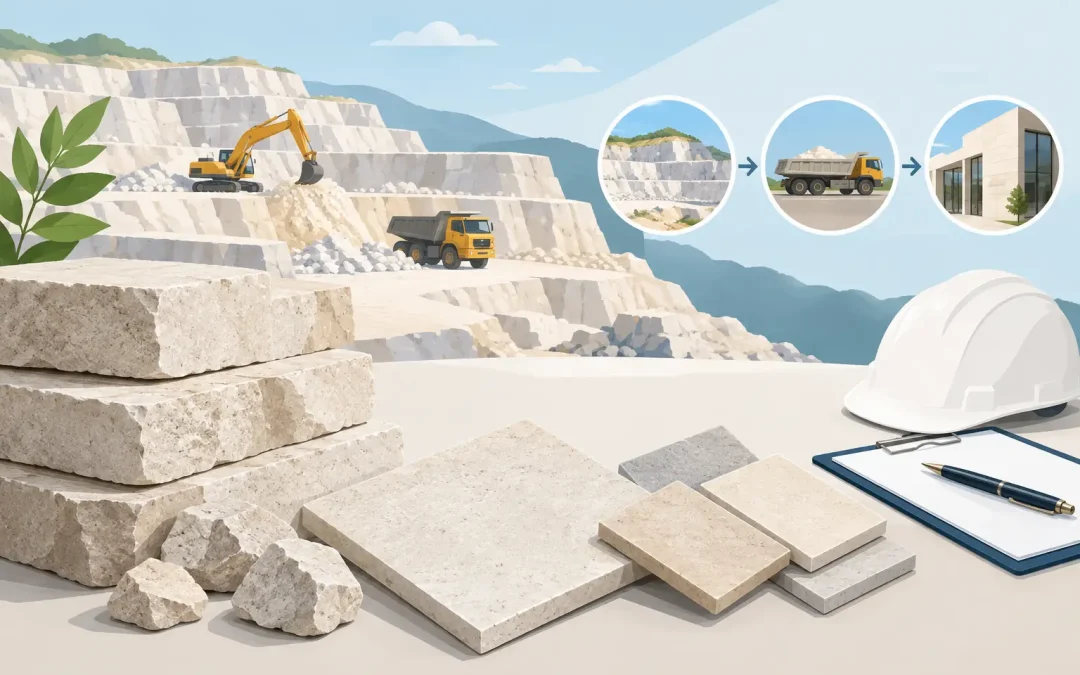
A façade can look resolved on a rendering long before its stone has been properly understood. That gap is where cost, programme and design intent can begin to drift. This natural limestone procurement guide is written for project teams who need to select with confidence: not simply a pale stone, but a particular geological material, from a known source, in a finish and format suited to the building.
Natural limestone rewards careful procurement. Its variation is part of its value, yet variation must be anticipated rather than treated as a late-stage surprise. The most successful specifications establish the stone’s provenance, visual character, technical requirements and fabrication route early enough for each decision to inform the next.
Start with the architectural role of the stone
Before comparing samples, define what the stone must do. Limestone used as a finely jointed façade has different priorities from limestone paving around a pool, internal wall cladding in a hotel lobby or hand-carved detailing at an entrance. Exposure, scale, fixing method, desired tactility and the relationship with adjacent materials all influence the appropriate bed, finish and thickness.
For external applications, consider orientation and weathering from the outset. A sheltered urban elevation and a coastal site subject to salt-laden air are not equivalent conditions. Slip resistance, drainage, cleaning regimes and expected patina deserve equal attention for paving. Indoors, the question may be less about weather resistance and more about reflectance, consistency across large wall areas, edge detailing and the feel of the surface under hand.
A clear material brief should describe the intended character as well as the application. Terms such as warm white, textured or traditional are too broad on their own. Reference whether the design calls for a quiet, relatively even ground; visible shell content; open fossil texture; sawn precision; or a more expressive, hand-finished face. These distinctions narrow the field far more effectively than colour alone.
Natural limestone procurement guide: specify provenance
Limestone is not a commodity with a uniform appearance or performance profile. A quarry name, geological bed and extraction source are meaningful specification information. They provide a line of sight to the material’s visual range, manufacturing capability and continuity of supply.
British Portland Stone is a useful example. Drawn from the Isle of Portland in Dorset, it has an architectural heritage evident in landmark buildings including St Paul’s Cathedral and Buckingham Palace. Yet Portland Stone is not one single appearance. Basebed, Grove Whitbed, Jordans Whitbed, Roach and Stonehills Whitbed each offer a distinct expression, from comparatively clean and refined beds to richly shelly, character-led material.
That choice should be deliberate. A fossil-rich Roach may give a contemporary façade or feature wall remarkable depth, while a quieter Whitbed can support formal elevations and finely detailed interiors. Heritage Portland Stone and Portland Stone bricks offer further ways to bring the material’s established architectural language into new work. The right selection depends on the visual ambition of the project and where variation will be most visible.
Ask the supplier to identify the precise stone proposed, rather than accepting a generic description such as “Portland limestone” or “European limestone”. Confirm the quarry source, bed, country of origin and whether the material is available in the formats required. This safeguards both authenticity and design continuity if the project is staged.
Sample for the building, not the boardroom
A small sample is an introduction, not a guarantee of the complete installation. Natural stone should be reviewed at a meaningful scale and, wherever possible, in the light conditions in which it will be seen. Morning sun, deep shade, artificial lighting and a wet surface can all alter the perceived colour and texture.
For substantial works, a control sample or site mock-up is worth the time. It allows the team to assess the selected bed, finish, joint width, pointing colour, panel proportions and fixing approach together. It also establishes an agreed benchmark for natural movement in tone, fossil content and veining. Seeking absolute uniformity from a geological material can lead to unnecessary rejection, delayed production and a result that feels less authentic than the architecture intended.
The approval process should distinguish unacceptable defects from expected characteristics. Shells, pores, bedding marks and tonal variation may be intrinsic to the chosen stone. Conversely, staining, unsuitable repairs, dimensional inaccuracy or finish inconsistency may warrant action. Put these criteria in writing before manufacture begins.
Align format, finish and fabrication early
The format of the stone is a design and procurement decision at once. Large-format cladding may create an elegant, monolithic reading but can require more exacting logistics, handling and engineered support. Smaller ashlar, tiles or bricks can accommodate complex geometry and offer a different rhythm, although jointing becomes more prominent.
Finishes require the same discipline. A honed face can bring calm refinement to internal flooring or wall lining, while a sawn, tooled or split-faced finish may better suit an exterior where texture and grip are required. The desired finish must be confirmed against the specific limestone bed. A finish that appears subtle on one material may expose a more pronounced fossil structure on another.
Bespoke carved stonework should enter the programme especially early. Profiles, mouldings, copings, surrounds, balustrade components and sculptural pieces depend on approved shop drawings, block selection and skilled manufacturing. Their value lies partly in this precision. Treating them as a late substitute for standard units compromises both lead time and outcome.
For Australian projects, London Stone Co provides exclusive access to Portland Stone supplied through Albion Stone, a fourth-generation English family business recognised for both advanced manufacturing and traditional stonemasonry. Such a direct quarry and manufacturing relationship matters when a scheme requires coordinated cladding, paving, bricks and bespoke elements rather than isolated stone purchases.
Test performance against the actual application
Technical data should answer the conditions of the project, not merely satisfy a generic material schedule. Review relevant information on density, water absorption, compressive strength, flexural strength, abrasion resistance and slip resistance where applicable. The required tests and acceptance criteria will vary according to whether the stone is used as flooring, paving, ventilated façade cladding, bonded wall lining or solid masonry.
The stone itself is only part of the system. External cladding performance depends on substrate, cavity design, anchors, restraint, movement joints and detailing around openings. Paving performance depends on the preparation beneath it, falls, drainage and installation method. A premium limestone cannot correct an unsuitable substrate or poorly resolved edge condition.
Coordinate early with the façade engineer, structural engineer, stone contractor and installer. Confirm thicknesses, unit weights, tolerances and fixing zones before finalising module sizes. This is particularly valuable where panels are large, reveals are deep or the design includes returns, curved walls and carved components.
Procure to the programme, including the unseen stages
Imported limestone has a procurement sequence that extends beyond quarry extraction. Block allocation, cutting, finishing, quality checks, packing, sea freight, customs clearance, local storage and delivery all require allowance. Bespoke pieces and large-format orders may require additional production planning, particularly where the quarry must select material with a compatible visual character across a complete elevation.
Avoid issuing a stone order solely on a provisional finish schedule. The order should capture approved sample references, unit dimensions, tolerances, finish, edge treatment, quantities, labelling requirements, packaging and delivery sequence. Allow a sensible overage for cutting and selection, but calculate it with the fabricator rather than applying a blanket percentage to every product. Complex patterns and heavily veined or fossil-rich selections may need different allowances from standard tiles.
Delivery sequencing deserves close attention on constrained sites. Stone should arrive when it can be stored dry, protected from contamination and lifted safely without repeated handling. Panels, paving and delicate carved pieces often need separate packing strategies. A well-managed delivery is not merely operational efficiency: it protects finished faces before they reach the building.
Protect the material through installation and handover
The appearance of limestone at completion is shaped by installation practice. Confirm suitable adhesives, mortars, grouts and sealers with the supplier and installer, particularly where pale stone may be vulnerable to staining or where moisture movement must be managed. Any proposed cleaning product should be tested first. Acidic cleaners are generally inappropriate for calcareous stone and can permanently alter the face.
Specify a practical care regime for the client at handover. Natural limestone will acquire a patina, especially in landscape settings and high-touch interiors. That is not necessarily deterioration. The objective is to prevent avoidable staining and inappropriate cleaning while allowing the material to age with dignity.
The strongest stone specifications do not chase a perfect, static surface. They select a proven material, give it the correct technical support and allow its natural character to become part of the building’s identity. Begin the procurement conversation while the architecture is still flexible, and the finished work will retain the clarity and permanence that drew the project to natural limestone in the first place.
Recent Comments