
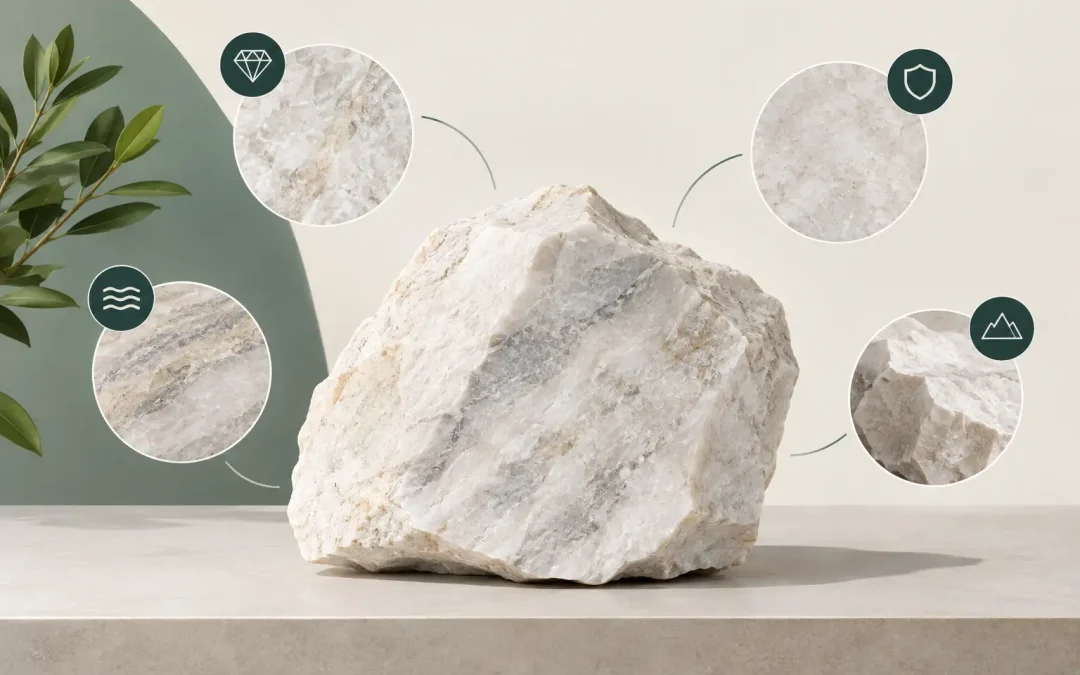
Jordans Whitbed stone characteristics make it one of the most compelling choices within the Portland Stone family for projects seeking restrained colour, natural movement and an unmistakably British architectural presence. Quarried from the Isle of Portland in Dorset, this iconic limestone offers a pale, warm surface that can bring quiet distinction to façades, interiors, landscape elements and finely detailed masonry.
For Australian architects and project teams, its appeal lies not only in its appearance but in its provenance. Portland Stone has shaped some of Britain’s most recognised civic and cultural buildings, including St Paul’s Cathedral and Buckingham Palace. Jordans Whitbed carries that architectural lineage into contemporary work, where its fossil character and soft mineral palette offer an alternative to more uniform manufactured materials.
What defines Jordans Whitbed stone?
Jordans Whitbed is a Portland limestone selected from the Whitbed geological layer. It is valued for its creamy-white ground colour, gentle tonal variation and visible natural shell content. Rather than presenting as a flat, sterile white, it has depth: pale ivory, light biscuit and subtle grey-beige notes may appear across the face of the stone.
The stone’s character comes from the ancient marine environment in which it was formed. Fossilised shell fragments and occasional larger fossil features create visual interest without overwhelming a design. This balance is central to its architectural value. Jordans Whitbed can read as calm and refined from a distance, then reward closer inspection with texture, mineral detail and a sense of geological time.
As with every genuine natural stone, samples should be understood as an indication rather than a complete record of the finished surface. Variation between blocks, production batches, finishes and lighting conditions is part of the material’s authenticity. A broad elevation may appear more consistent than a honed internal wall, while raking light can reveal shell content and tooling marks with greater clarity.
Colour and surface character
The defining visual quality of Jordans Whitbed is its light, warm neutrality. It works particularly well where a project requires a pale limestone without the clinical effect sometimes associated with pure white materials. In strong Australian sunlight, the stone can appear clean and luminous; in softer interior conditions, its cream and honeyed undertones become more apparent.
This flexibility makes it suitable for a wide range of architectural palettes. It can sit comfortably beside dark bronze, blackened steel, timber and contemporary glazing, or support more classical compositions with rendered walls, brickwork and traditional joinery. The stone has enough natural variation to add life to minimalist architecture, yet remains sufficiently composed for formal civic, hospitality and prestige residential settings.
Shells are an important part of the material’s identity. Their size, density and distribution will vary, from fine fragments that create a lightly granular appearance to more pronounced inclusions that provide a distinctive focal detail. Designers who prefer the most uniform possible appearance should discuss block selection, expected variation and finish options early in the specification process. Those seeking a more expressive material often value the same fossil content as a defining design feature.
Texture, grain and workable detail
Jordans Whitbed is a freestone limestone, meaning it can be worked in any direction without a pronounced natural grain dictating how it must be cut. This gives stonemasons and fabricators considerable freedom when producing architectural elements, including ashlar, walling, copings, stair components, cornices, fireplace surrounds, paving and bespoke carved details.
Its relatively fine texture supports crisp workmanship, while its shell content retains a natural, tactile quality. The finished expression depends greatly on the selected surface treatment. A sawn finish is direct and contemporary, exposing the stone’s natural matrix. Honing creates a smoother, more measured surface suited to interiors and selected architectural details. Textured or tooled finishes can introduce greater shadow, slip resistance and visual depth for landscape or external applications.
The choice of finish should never be treated as purely aesthetic. A highly refined surface may be appropriate for an internal wall lining but less suitable for a heavily trafficked external setting. Similarly, a more textured paving finish may be technically appropriate around entries, terraces or pool environments while producing a distinctly different visual result from a honed cladding panel.
Bed orientation and visual consistency
The orientation in which Portland Stone is cut can influence its appearance, particularly where fossil features are more visible. Project teams should establish expectations for face orientation, panel layout and jointing during the design and sample approval stages. This is especially relevant for large wall areas, book-matched compositions, moulded work or elevations where tonal flow matters.
Good stone specification considers the wall as a whole, not simply an isolated sample. Panel dimensions, coursing, joint width, fixing strategy and adjacent materials all influence the final reading of Jordans Whitbed.
Performance considerations for Australian projects
Portland Stone has a long history of use in demanding architectural applications, but natural stone performance should be assessed in relation to the specific project. Climate, exposure, installation method, detailing, intended maintenance and finish selection each matter. The correct question is not whether Jordans Whitbed is suitable in the abstract, but whether the proposed product format and design detail are suitable for the location and use.
For external cladding, careful engineering of the support system, movement joints, cavity ventilation and water management is essential. Stone must be detailed to shed water and avoid conditions that allow moisture to be retained behind or within the installation. In coastal locations, material selection and fixing design require particular attention because of salt exposure, wind-driven rain and elevated maintenance demands.
For paving, the finish, thickness, substrate preparation and drainage strategy should be considered together. Limestone brings elegance and permanence to courtyards, thresholds and garden spaces, but it is not a material to specify on appearance alone. Areas exposed to water, food service, high foot traffic or pool chemicals may require a tailored finish, appropriate sealing strategy and a realistic maintenance programme.
Internally, Jordans Whitbed can be used to create a composed sense of permanence in entry halls, fireplaces, feature walls, bathrooms and hospitality spaces. Here, the principal considerations tend to be surface finish, jointing, cleaning practices and protection during construction. Natural limestone is more nuanced than ceramic or engineered surfaces: it should be cleaned with products suitable for calcareous stone and protected from aggressive acids or inappropriate treatments.
Jordans Whitbed compared with other Portland Stone varieties
Within the Portland Stone range, Jordans Whitbed occupies a distinctive position. Its pale Whitbed character and fossil interest make it an attractive choice where a project calls for a light, expressive limestone with a recognisably natural face. It is often considered alongside Grove Whitbed, Stonehills Whitbed and Basebed, although each variety has its own colour balance, shell content, texture and architectural effect.
Basebed is generally selected where a more consistent and comparatively fine appearance is desired. Whitbed stones, including Jordans Whitbed, are often appreciated for their greater visible shell character and softer movement. Roach sits at the more overtly fossil-rich end of the Portland Stone spectrum, with a bold open texture that can become a feature in its own right.
There is no universally superior choice. A minimal residential façade may benefit from the measured consistency of one stone, while a boutique hotel lobby or sculptural garden wall may call for the livelier character of another. Viewing full-size samples and discussing the intended application with a specialist supplier remains the most reliable way to make the distinction meaningful.
Specifying Jordans Whitbed with confidence
A strong specification should identify more than the stone name. It should define the proposed application, finish, thickness, unit dimensions, edge details, anticipated colour range and any requirements for mock-ups or sample panels. Where the stone will form a major public-facing elevation or a finely detailed interior, early coordination between architect, stone supplier, fabricator, engineer and installer is particularly valuable.
It is also prudent to allow for the realities of natural material production. Quarry yield, block character and lead times can affect the most efficient module sizes and finish options. Engaging early gives the project team greater control over stone selection and helps align design ambition with responsible sourcing, fabrication and installation planning.
As the exclusive Australian supplier of Albion Stone’s Portland Stone range, London Stone Co can support project teams with access to Jordans Whitbed in cladding, paving, tiles, masonry units and bespoke architectural stonework. Albion Stone is a fourth-generation English family business recognised for both advanced manufacturing and traditional stonemasonry capability, bringing unusual depth of technical and material knowledge to complex stone projects.
For architecture intended to acquire presence rather than merely finish a surface, Jordans Whitbed offers a considered starting point: a pale British limestone with fossil memory, proven heritage and enough natural individuality to make each completed project its own.
Recent Comments