
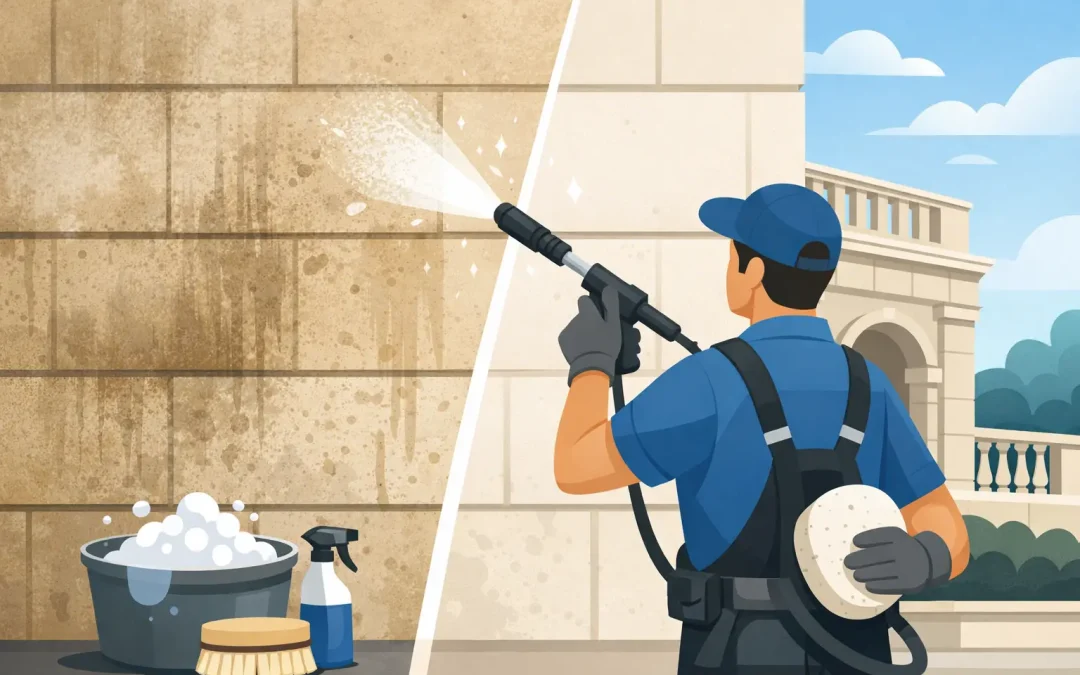
Portland Stone does not need aggressive cleaning to look distinguished. Its quiet, pale character, fossil detail and gently varied surface are part of its appeal – whether it is specified as a finely detailed façade, a paved courtyard, a fireplace surround or bespoke carved work. Knowing how to clean Portland stone begins with respecting it as a natural limestone, rather than treating it like a hard, impervious tile.
The right approach removes surface dirt while retaining the stone’s natural finish. The wrong one can etch the face, drive contaminants deeper into the pores or leave a patchy appearance that is far more difficult to resolve than the original stain.
Why Portland Stone needs a considered cleaning method
Portland Stone is an iconic British limestone formed over millions of years and valued in landmark architecture, including St Paul’s Cathedral and Buckingham Palace. Like many limestones, it contains calcium carbonate. This is the decisive practical point: acids react with calcium carbonate and can permanently dull, roughen or mark the surface.
Its porosity also matters. Portland Stone can absorb water and staining agents, particularly where it is honed, textured or used horizontally as paving. Basebed, Grove Whitbed, Jordans Whitbed, Roach and Stonehills Whitbed each have their own visual character and shell content, but all benefit from a measured, pH-neutral maintenance regime.
A cleaning method should therefore be selected according to the stone’s location, finish, age and the nature of the soiling. A newly installed internal floor with builder’s dust is not the same cleaning task as a weathered external façade or a paved entertaining area affected by leaf tannins and barbecue residue.
How to clean Portland stone for routine maintenance
For most internal and external applications, regular low-impact cleaning is the most effective form of care. Remove loose grit first with a soft broom, vacuum fitted with a soft brush head, or clean microfibre mop. This prevents abrasive particles from being dragged across the surface during washing.
Wash the stone with clean water and a pH-neutral cleaner specifically suitable for calcareous natural stone. Follow the cleaner manufacturer’s dilution guidance rather than assuming that a stronger mix will produce a better result. Apply with a soft cloth, mop or non-abrasive white pad, keeping the amount of water controlled, particularly on interior floors and around open joints.
Rinse with clean water where the product instructions require it, then remove excess moisture with a clean mop or cloth. On paving, a gentle rinse from a hose is generally sufficient. Allow the stone to dry naturally before judging the result, as Portland Stone can appear temporarily darker when wet.
For polished or finely honed interior work, use the least amount of water practical and dry the surface promptly. For split-faced cladding or carved details, soft natural-bristle brushes are often more effective than cloths because they can lift dust from texture without abrading the stone.
What not to use on Portland Stone
Avoid household shortcuts that are routinely recommended for ceramic tiles, concrete and engineered surfaces. Portland Stone should never be cleaned with vinegar, lemon juice, acidic bathroom cleaners, descalers or brick acid. These products can cause etching – a chemical attack that leaves the limestone lighter, rougher and permanently altered.
Chlorine bleach, strong alkaline degreasers and undiluted detergents should also be avoided unless a stone-care professional has confirmed their suitability for the exact stain and finish. They may discolour the stone, weaken adjacent sealers or leave residues that attract further dirt.
Do not use wire brushes, abrasive scourers, sanding discs or high-pressure washing at close range. Pressure washing can strip away the softer surface, open the pore structure and damage pointing or joints. The result may look clean briefly, but it can accelerate future weathering and biological growth.
Treating stains without creating a larger problem
The first rule with a fresh spill is simple: blot, do not wipe. Wiping spreads oil, wine, coffee or coloured liquids across a greater area. Lift the spill with an absorbent cloth or paper towel, then clean the area with a pH-neutral stone cleaner and clean water.
Oil-based marks from cooking, cosmetics or machinery may require a specialist poultice designed for natural stone. A poultice draws the contaminant from the pores as it dries, rather than attempting to dissolve it into the stone. This process can require more than one application, especially on unsealed paving or honed flooring.
Organic stains, such as leaves, berries, bird droppings or plant matter, should be removed as soon as possible. On external paving, regular sweeping is not merely cosmetic: it limits the time tannins and moisture remain in contact with the surface. For persistent marks, seek advice on a proprietary limestone-safe stain remover before applying any chemical treatment across a visible area.
Rust staining requires particular care. It can originate from fertiliser, metal furniture, steel fixings, contaminated water or embedded particles introduced during construction. Standard rust removers are commonly acidic and are therefore unsuitable for Portland Stone. A specialist product formulated for calcite-based stone, tested in an inconspicuous location, is essential.
Paint, silicone, adhesive and cement residues are best addressed by the contractor or a specialist stone conservator. Mechanical removal and unsuitable solvents can damage a premium finish quickly, especially on heritage-style bricks, finely worked reveals and bespoke carved elements.
External Portland Stone: algae, pollution and weathering
External stone will acquire a degree of environmental character. In coastal, shaded or high-rainfall settings, algae and lichen may develop where surfaces remain damp. Urban façades can collect atmospheric deposits, while paving can receive tyre marks, soil and organic debris. Not every change in tone is a defect, and uniformity is not always an appropriate goal for genuine natural stone.
Begin with dry brushing and clean-water washing. If biological growth persists, use only a biocidal treatment approved for limestone, following its dwell time, dilution and rinsing requirements precisely. Protect surrounding planting, metals and adjacent materials during application.
Where a façade is extensive, elevated or architecturally significant, cleaning should be planned as a conservation exercise rather than a maintenance chore. Test panels are valuable. They establish the appropriate method, expected colour change, water management and acceptable level of retained patina before work proceeds across the building.
Should Portland Stone be sealed?
Sealing is not always necessary, and it should not be used as a substitute for good detailing or regular care. A breathable, penetrating impregnating sealer can be useful for internal floors, kitchen-adjacent surfaces and external paving where staining exposure is high. It reduces absorption and gives more time to respond to spills without creating a visible surface film.
For vertical cladding and façades, the decision depends on exposure, detailing, stone finish and project requirements. An inappropriate sealer can alter appearance, trap moisture or weather unevenly. It is prudent to approve a sample area in the final stone selection and finish before specifying a treatment across the project.
Sealers also require maintenance. Their performance diminishes with traffic, cleaning and weather exposure, so future reapplication should be anticipated in the building or landscape maintenance plan.
A practical care programme for project teams
Portland Stone performs best when its care is considered before handover. Builders should protect installed stone from mortar splashes, metal filings, paint overspray and pooled water. Landscape teams should avoid storing soil, fertiliser or wet leaves on paving. Facilities managers should receive a concise schedule identifying approved cleaning products, dilution rates and escalation procedures for stains.
For high-value residential, hospitality and commercial work, retain records of the stone type, finish, sealer where used and any approved cleaning trials. This is particularly useful where a project combines paving, cladding, bricks and bespoke details, each of which may need a slightly different maintenance approach.
London Stone Co recommends that any unfamiliar cleaning product is tested on a discreet offcut or concealed area first. A small test can reveal changes in colour, texture or water absorption before they affect a completed elevation or floor.
Portland Stone rewards restraint. Clean it gently, address spills early and allow the material’s natural variation to remain visible. That considered care preserves not only the surface, but the sense of permanence that makes this British limestone so compelling in ambitious architecture.
Recent Comments