
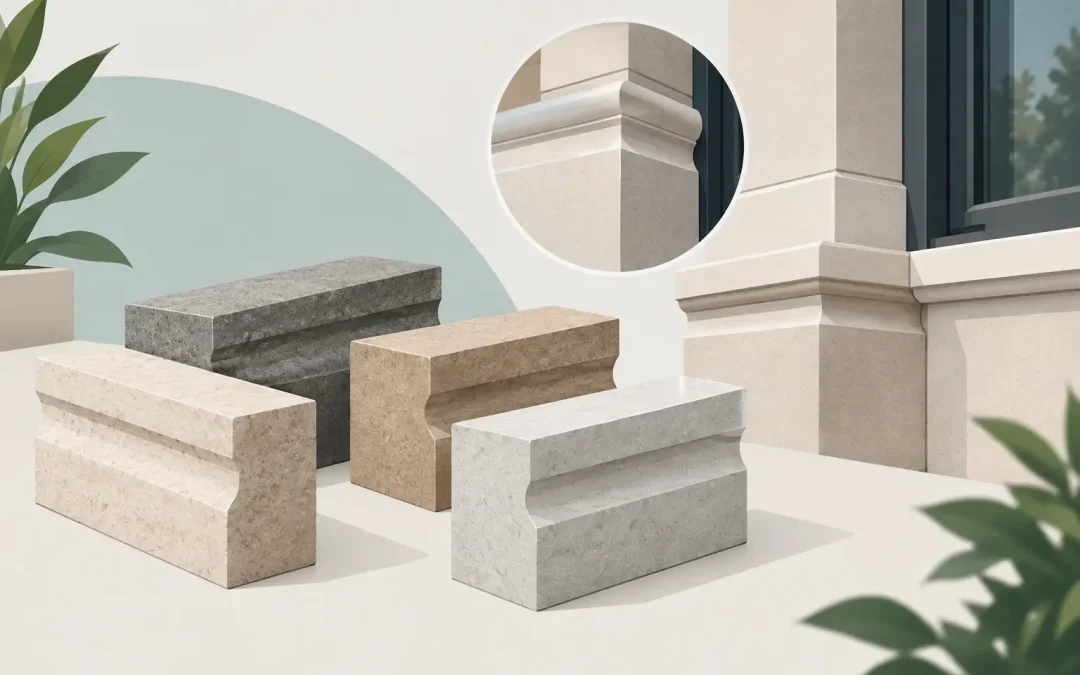
Roach is not a stone selected for visual uniformity. Its character lies in the fossil-rich shell structure, open texture and individual variation that give Portland Stone its unmistakable sense of age and place. Selecting Roach stone blocks therefore begins with a clear architectural intention: whether the project calls for a bold, expressive façade, finely resolved ashlar, sculptural landscape elements or a distinctive interior feature.
For ambitious and prestigious projects, Roach rewards considered specification. It is an iconic British Limestone with a pronounced geological story, quarried from the Isle of Portland and associated with some of Britain’s most enduring architecture. Its natural cavities, fossil fragments and warm pale tone create a surface that cannot be replicated by manufactured stone. Those same qualities require the design team to select blocks with care, understand how the stone will be worked and agree expectations for variation before fabrication begins.
What distinguishes Portland Roach?
Portland Roach is a shell-rich limestone, formed from compressed marine deposits. Unlike the more even appearance of Portland Basebed or Whitbed varieties, Roach contains visible fossilised shells and natural voids. The result is a materially expressive stone with depth, shadow and a tactile, time-worn quality.
No two blocks present in precisely the same way. One may show tightly packed shell fragments, while another has larger open fossils or a quieter field between them. This is not a defect to be removed from the selection process. It is the defining feature of Roach, and the reason it is often chosen for architecture seeking presence rather than perfect regularity.
The design question is not whether Roach will vary. It will. The more useful question is how that variation should appear across the completed elevation, wall, paving field or carved component.
Selecting Roach stone blocks by application
The intended use should guide selection from the outset. A block suitable for substantial external walling may not be the best choice for a highly detailed carved profile, and a block chosen for a feature pier may warrant more dramatic fossil expression than one used within a broad, repetitive façade module.
Façades and external walling
For façades, consider the viewing distance and scale of the elevation. At street level, larger fossils and open texture can read as richly architectural, particularly where sunlight creates relief across the face. From a greater distance, a very open Roach can appear more animated than a quieter block, which may be desirable for a landmark entrance or less appropriate where a restrained architectural rhythm is required.
Discuss the preferred range of shell content with the stone supplier and fabricator. A project need not aim for identical units, but it should establish a coherent visual family. Where coursed ashlar or large-format panels are proposed, block allocation and face layout should be reviewed before cutting so more pronounced material is placed intentionally rather than incidentally.
External detailing also deserves careful thought. Deeply recessed joints, strong reveals and honest stone thicknesses allow Roach to perform visually at its best. Trying to make this expressive limestone behave like a perfectly flat, homogenous cladding material can diminish the very quality that makes it compelling.
Carved work and architectural details
Roach can bring exceptional character to carved elements, including copings, surrounds, piers, plinths, fireplaces and bespoke features. Yet the level of fossilisation matters. Fine arrises, delicate lettering and intricate ornamental work may call for a more considered block selection, particularly where large voids could interrupt a crisp line or narrow detail.
This is not an argument against using Roach for crafted work. Rather, it is a case for matching the block to the carving. A bold moulding or substantial hand-finished element can celebrate the material’s texture; a precision detail may benefit from a quieter area within the available block. Early dialogue between architect, stonemason and supplier prevents a design intent being compromised by an avoidable mismatch.
Landscape and retaining elements
In landscape architecture, Roach offers a rare combination of permanence and visual warmth. It can be specified for walling, steps, seating, coping and feature structures where the fossil texture will be encountered at close range. Its character is particularly effective in coastal settings, established gardens and projects where building and landscape are intended to share one material language.
For horizontal applications and exposed edges, the proposed finish, dimensions, drainage strategy and detailing need to be resolved as part of the stone selection. A natural limestone should be treated as a genuine architectural material, not an afterthought applied to a standard construction detail.
Assess the block, not only the sample
A small hand sample is useful for understanding colour and general texture, but it cannot convey the full character of a Roach block. The fossil distribution can shift materially across a larger piece of stone, and the eventual appearance will also be influenced by cutting orientation, surface finish, jointing and daylight.
For substantial projects, request imagery or inspection of the proposed material range where practical. This allows the team to assess the relationship between open and denser areas, overall tonality and likely visual movement across the face. It is especially valuable where the stone forms a principal elevation, a large internal wall or a sequence of repeated architectural components.
Natural variation should be documented in the project expectations. Drawings, schedules and samples can establish an intended palette, but they should not imply that every unit will reproduce a single photographed fragment. The most successful Roach projects use variation as part of their composition.
Bed orientation, sizing and fabrication
Stone has a natural bed, developed during its geological formation. The required orientation should be considered alongside block dimensions and the proposed application. Correctly resolving bed direction is part of sound stone design and affects how the finished pieces are cut, detailed and installed.
Block size also influences both appearance and efficiency. Larger units can convey gravitas and reduce the number of joints, but they demand appropriate handling, fixing design and fabrication planning. Smaller units may suit intricate geometry, curved work or a more articulated wall pattern. Neither approach is inherently superior. The right choice depends on architectural scale, logistics, structural engineering and the desired expression of the façade.
Fabrication should be discussed early, particularly for bespoke profiles or panels with returns, recessed details and complex interfaces. Roach can be supplied in a range of formats, but a well-developed cutting strategy helps make best use of the stone’s inherent character while respecting the project programme and material yield.
Choose a finish that honours the material
The surface finish changes how Roach is read. A sawn finish can offer a clean, contemporary counterpoint to the fossil texture. A tooled or more textured finish can deepen shadow and reinforce the stone’s traditional architectural lineage. Honed applications may be appropriate in protected interiors, where the limestone’s warmth and shell detail can be appreciated at close quarters.
The decision should be made in relation to light, touch and adjacent materials. Roach set beside dark metal, fine bronze detailing or timber can feel precise and contemporary. Combined with deeper reveals, lime-based mortar and substantial masonry proportions, it can carry a more classically grounded character. Its versatility comes from authenticity, not from trying to make it neutral.
Plan for supply with the architectural programme
Portland Stone is a quarried material, and premium imported stone requires programme discipline. Finalising dimensions, quantities, finish schedules and approval processes early gives the project team the best opportunity to secure material that suits the intended visual outcome. Late changes to module sizes or profiles can affect yield, fabrication sequencing and availability.
This is where specialist supply matters. London Stone Co provides exclusive Australian access to Portland Stone from Albion Stone, a fourth-generation English quarrying and manufacturing business recognised with more than 70 natural stone awards. That direct connection supports informed conversations about available formats, manufacturing capability and the particular qualities of each Portland Stone variety.
Roach is at its most convincing when it is allowed to be Roach: fossil-rich, individual and visibly geological. Select blocks with a defined purpose, give the material enough scale to speak, and let the finished architecture carry the quiet authority of stone formed over millions of years.
Recent Comments