
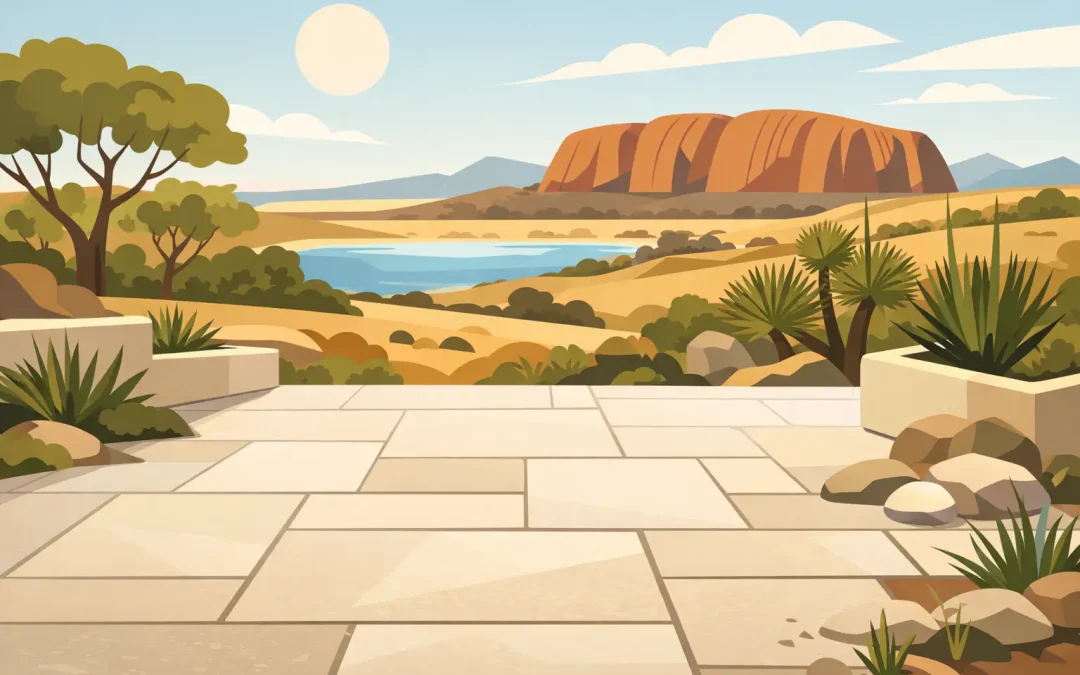
A paved terrace can determine whether a landscape feels merely finished or truly composed. Portland stone paving brings the quiet authority of iconic British limestone into Australian gardens, pool surrounds, courtyards and hospitality settings, where material character must stand up to close inspection as well as daily use.
Quarried on the Isle of Portland in Dorset, this distinctive natural limestone has shaped some of Britain’s most recognised civic and cultural buildings, including Buckingham Palace and St Paul’s Cathedral. Its significance is not simply historical. Portland Stone offers designers a restrained, luminous surface with natural fossil detail, tonal movement and a sense of permanence that manufactured paving rarely replicates.
Why Portland Stone Paving Has Lasting Design Value
Portland Stone sits comfortably within both classical and contemporary architecture because it does not depend on a passing colour trend. Its pale, mineral palette can range from soft cream to warm grey-beige, creating a composed transition between built form and landscape. In strong Australian light, that tonal subtlety becomes particularly valuable: the surface has presence without visual noise.
Each piece carries variation formed over geological time. Fine shell fragments, fossil markings and open-textured areas are not defects to be designed out; they are integral to the stone’s identity. A large paved area therefore reads as a connected natural field rather than a repeated manufactured pattern. This quality gives terraces and courtyards visual depth even where the architectural palette is deliberately minimal.
The stone’s heritage also has practical relevance for projects intended to endure. Portland Stone has been selected for landmark architecture across centuries because it can be worked with precision, detailed with confidence and renewed where required. For a residence, hotel or institutional project, paving in the same material family as wall cladding, steps, coping or carved details can establish a disciplined material language from threshold to landscape.
That said, heritage should not be confused with uniformity. Natural limestone is chosen for its variation, and samples should be viewed as an indication of colour, texture and fossil content rather than a promise that every paver will look identical. The most successful specifications allow the material to remain recognisably natural.
Choosing the Right Portland Stone Variety
Portland Stone is not one single appearance. The quarry’s different beds offer distinct visual characteristics, allowing the paving selection to respond to the architectural brief and the desired level of movement.
Grove Whitbed and Jordans Whitbed are often valued for their refined, pale ground and relatively consistent appearance. They can suit formal courtyards, elegant entrance terraces and contemporary projects where calm tonal continuity is central to the design. Stonehills Whitbed offers another pale Portland expression with its own natural texture and character.
Basebed is a versatile choice with a warmer, more varied limestone presence. Its visual depth can work especially well in broad entertaining terraces or garden paths, where the paving should feel established within planting and weathered timber rather than overly pristine.
Roach is the most distinctive Portland variety, recognised for its visible fossil content and open shell structure. It makes a confident architectural statement and is particularly effective where a project welcomes expressive natural detail. It may not be the appropriate choice for every finely restrained scheme, but in the right setting it brings a level of geological interest that cannot be replicated by a printed surface.
The choice is therefore not simply pale versus darker, or smooth versus textured. It is a decision about the relationship between paving, façade materials, shadow, planting and use. Reviewing substantial samples alongside the project’s joinery, render, masonry and pool finishes is preferable to choosing from a small swatch in isolation.
Specifying Portland Stone Paving for Australian Conditions
A premium stone selection deserves equally considered technical coordination. Paving thickness, format, finish, substrate and drainage should be resolved early with the architect, landscape architect, installer and relevant technical advisers. A beautiful limestone can only perform as intended when the assembly beneath it is appropriate to the site.
For external paved areas, surface finish matters. A honed finish may suit protected outdoor rooms or covered spaces, while a more textured finish is generally the more appropriate consideration for exposed terraces, paths and wet zones. Pool surrounds require particular attention to slip resistance, water management, salt exposure and the client’s maintenance expectations. The right solution depends on the stone type, finish, local conditions and applicable project requirements rather than a blanket rule.
Australian climates also demand careful planning around heat, rainfall and movement. Light-coloured Portland Stone can be an appealing option for sun-exposed areas because it avoids the visual heaviness of darker paving, but surface temperature should still be assessed in the context of orientation, shade and the surrounding materials. In high-rainfall locations, falls and drainage must direct water away effectively. In coastal environments, designers should consider airborne salts, wind-driven moisture and the maintenance regime from the outset.
Joint design should support the intended aesthetic and the movement requirements of the paving system. Very tight joints can produce a monolithic contemporary appearance, while wider joints may suit a more relaxed or traditional landscape composition. Neither approach is inherently superior. The detailing must be compatible with selected formats, tolerances, substrate construction and drainage performance.
Formats That Give a Landscape Its Rhythm
Format has a significant effect on the character of a Portland Stone surface. Large-format paving can make a compact courtyard feel more generous, reducing joint lines and allowing the limestone’s tonal field to read clearly. It is well suited to contemporary architecture, although large units require accurate setting-out, sound substrate preparation and considered handling during installation.
Smaller rectangular formats introduce rhythm and can respond elegantly to irregular site geometry. They suit paths, garden rooms and projects where the paving needs to relate to brickwork, stone walling or existing heritage elements. Modular arrangements offer another route, creating a measured pattern without becoming decorative for its own sake.
Steps, landings, thresholds and pool copings should be designed as part of the same composition, not treated as late additions. A change in thickness, edge detail or finish can provide necessary functional definition while preserving continuity. Bespoke cut pieces are often worthwhile at door openings, curved edges and feature junctions, where awkward narrow cuts would otherwise undermine a carefully composed surface.
Installation and Care Are Part of the Specification
Natural stone paving is not a fit-and-forget material, nor should it be treated as fragile. It rewards correct installation and proportionate care. The installer should have demonstrated experience with premium natural stone, understand the importance of substrate tolerances and use materials compatible with limestone. Poor drainage, inappropriate bedding methods or careless handling can compromise even the finest paving before the project is complete.
Before installation begins, the team should agree on the blend and distribution of pavers. Because Portland Stone contains natural variation, the paving should be drawn from multiple crates and laid out with an eye to tonal balance. This avoids concentrated areas of similar colour or fossil character and produces a more natural overall result.
Sealing is a project-specific decision rather than an automatic requirement. The desired finish, expected staining risk, location and selected stone should inform the approach. Any treatment should be tested on a sample first, particularly where the design relies on Portland Stone’s pale colour and natural surface expression. Routine cleaning should be gentle and appropriate for calcareous stone; harsh acidic products can damage limestone and should not be used.
Over time, an external stone surface will develop evidence of use and weather. For many discerning clients, that softening is part of the appeal. A sheltered formal terrace may retain a cleaner appearance, while garden paving beneath trees will acquire a more lived-in character. Establishing this expectation early helps clients value the patina rather than mistake it for a failure of the material.
A Material With Provenance Behind It
For ambitious Australian projects, provenance is as important as appearance. London Stone Co provides exclusive Australian access to Portland Stone from Albion Stone, a fourth-generation English family business recognised for advanced manufacturing, traditional stonecraft and more than 70 natural stone awards. This connection provides project teams with access to an iconic British limestone in paving, tiling, cladding, bricks and bespoke carved elements.
That breadth makes Portland Stone especially compelling where the landscape is intended to feel inseparable from the architecture. The same geological material can continue from a façade to an entry, from a courtyard floor to a garden wall, or from a pool terrace to carefully resolved coping. The result is not simply a collection of premium finishes, but a project with material coherence.
The best time to consider Portland Stone paving is before the landscape has been reduced to a schedule of hard surfaces. Allow the stone to influence the palette, the proportions of the terrace, the direction of the joints and the meeting of house and garden. When given that level of consideration, Portland Stone does more than cover the ground: it gives a place a lasting sense of arrival.
Recent Comments