
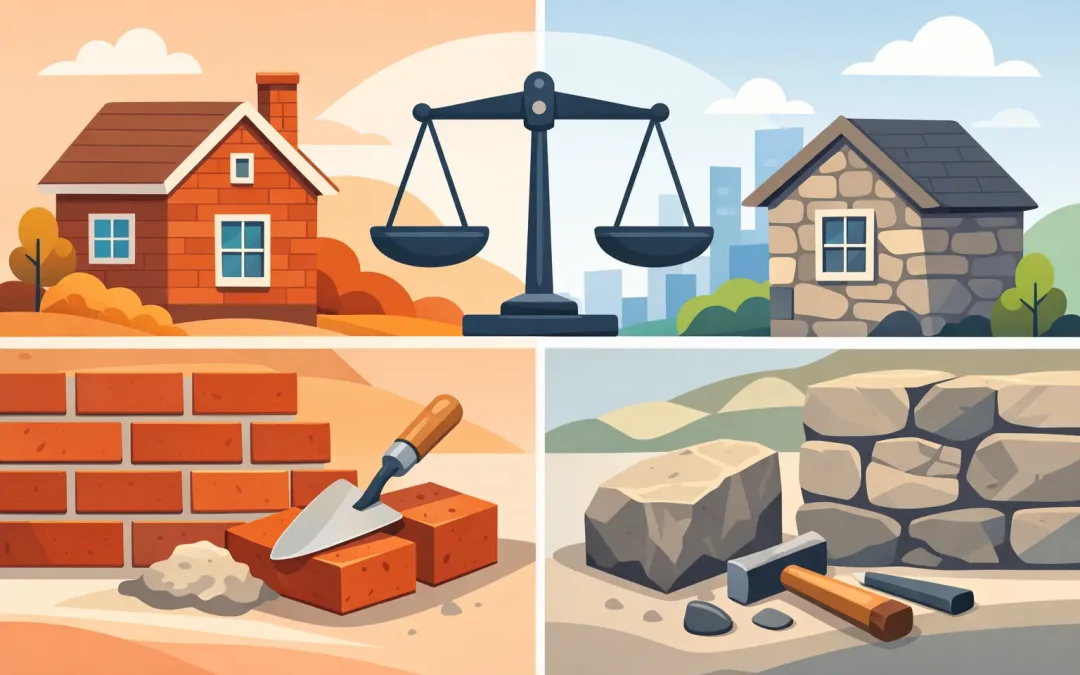
A façade can be structurally sound, beautifully proportioned and immaculately built, yet still feel ordinary if its material lacks presence. So, which is better brick or stone? For ambitious residential, hospitality and civic work, the more useful question is which material best expresses the architecture, responds to the site and will retain its authority over generations.
Brick and natural stone are both enduring building materials, but they create very different results. Brick establishes rhythm, texture and familiarity. Stone brings geological depth, scale and a sense of permanence that cannot be replicated by a manufactured finish. The right choice is rarely about one material being universally superior. It is about understanding what each can contribute to the project.
Which Is Better Brick or Stone for Architecture?
Brick is often the practical favourite where repetition, economy and local character are central to the brief. Its modular dimensions make it efficient for walls, screens and detailed patterns, while its extensive colour range gives designers considerable control over tone. A carefully selected brick can be restrained and contemporary or richly textured and traditional.
Natural stone operates differently. Each piece carries variation in grain, fossil content, veining and surface texture. This variation gives a building visual depth, particularly across large elevations, where light moves over the face of the stone throughout the day. In a project intended to feel established rather than merely finished, stone has a distinctive advantage.
Portland Stone is an iconic British limestone whose quiet palette and fine-grained character have made it integral to landmark architecture, including St Paul’s Cathedral and Buckingham Palace. Its enduring appeal is not limited to heritage settings. Cut into precise ashlar, contemporary cladding, paving or carved architectural details, it can look notably crisp and modern.
The decision, therefore, is not simply brick versus stone. It is modularity and repetition versus mass and material presence; a familiar construction language versus a natural material with a long architectural lineage.
Character, Scale and Design Intent
Brick is read piece by piece. Mortar joints are integral to its appearance, establishing a grid that can make an elevation feel lively, ordered or deliberately informal. Bond pattern, joint profile and mortar colour all matter. A change in mortar can alter the perceived colour of an entire wall as much as a change in the brick itself.
Stone is read in larger fields. Bed heights, joint widths, arrises and panel proportions carry greater visual weight than a standard brick module. This allows stone façades to create calm, generous surfaces, particularly suited to projects with strong geometry and carefully considered openings. Stone can also move effortlessly from façade to threshold, courtyard paving, stair treads and landscape walls, helping the architecture feel composed as one whole.
For a finely detailed urban residence, a hospitality entrance or a prestige commercial frontage, this continuity is valuable. The material can frame a door, form a plinth and continue into an internal floor without losing credibility. Brick can achieve variation through format and bonding, but it is less naturally suited to monolithic elements such as substantial steps, copings, sculptural details and carved surrounds.
That does not mean stone belongs only on grand buildings. Used selectively, it can give a modest project a memorable focal point: a limestone entry portal, a garden wall, a hearth or a paved terrace. Conversely, brick may be exactly right where the intention is to relate to a streetscape of masonry terraces or where a building needs a finer, more domestic scale.
Durability Is About Material and Detail
Both brick and stone can perform for generations, but neither should be treated as a generic category. Clay type, firing, density, quarry source, finish, fixing method and exposure all affect the outcome. A comparison based only on the word ‘brick’ or ‘stone’ misses the specification work that protects long-term performance.
Quality clay brickwork is proven, repairable and well understood by most builders. Its smaller units can make localised replacement relatively straightforward. It is, however, dependent on well-executed mortar joints, appropriate movement provision, careful flashing and sound cavity detailing. Poorly chosen bricks or inadequate workmanship can lead to staining, spalling and uneven weathering.
Natural limestone also requires informed specification. Its suitability should be considered against the project’s location, orientation, salt exposure, fixing strategy and intended application. A coastal façade, a busy public threshold and a sheltered internal wall will each place different demands on the stone and its finish. The natural porosity of limestone is not a defect, but a defining characteristic that must be respected in detailing, cleaning and maintenance planning.
The most successful stone projects allow the material to weather naturally rather than attempting to make it behave like a synthetic surface. Good drips, copings, drainage, ventilation and correctly designed joints are essential. So is a realistic understanding that a natural material will gain patina. For many architects and owners, that evolution is part of its value.
Cost Should Be Measured Across the Project Life
Brick will usually offer a lower initial material cost for large areas of standard walling, particularly where a readily available product and conventional construction method are appropriate. Labour, scaffold time, wall build-up, complex patterns and bespoke brick shapes can narrow that gap, so early cost comparisons should include the complete installed façade rather than a rate per unit alone.
Stone generally represents a higher initial investment. Quarrying, selecting, cutting, finishing, transporting and installing natural stone demand specialist capability. Bespoke profiles, curved elements and substantial blocks add further cost. Yet the upfront figure does not describe the whole proposition.
A well-designed stone façade or landscape scheme can provide enduring visual value, low replacement risk and a degree of distinction that standard materials cannot offer. On projects where arrival, identity and longevity matter, stone is often not an embellishment. It is a central part of the architectural proposition.
There is also value in using each material where it is strongest. Brick can form the principal walling, while stone defines the base, entry, window surrounds, terraces or communal spaces. This approach can create hierarchy without forcing stone into areas where its contribution would be diluted. It also gives a building a tactile relationship with the ground, where people encounter the material most closely.
Construction and Specification Considerations
Brickwork is familiar to a broad range of contractors, but a refined result still depends on mock-ups and clear documentation. Specify the brick, bond, mortar colour, joint finish, sample panel, blend percentage and acceptable colour variation. Without these decisions, the final elevation can vary significantly from the architect’s intention.
Stone calls for an equally disciplined process, often earlier in the programme. Establish the intended stone type, format, thickness, finish, edge treatment and fixing approach before finalising supporting structure and set-out. Large-format cladding needs coordinated tolerances and appropriately engineered support. Solid masonry, paving and carved work each have their own technical requirements.
The source matters as much as the drawing. Portland Stone includes distinct beds and appearances, from the relatively even character of Basebed and Whitbed to the more expressive fossil features of Roach. Selecting a stone by name alone is not enough. Project teams should review physical samples and, where possible, a representative control panel in the chosen finish.
As the exclusive Australian supplier of Albion Stone’s Portland Stone range, London Stone Co can assist project teams in matching these material decisions to the intended application. That access is particularly valuable where a scheme includes more than one format, such as cladding, paving, stone bricks and bespoke carved details, all requiring a coherent visual outcome.
Where Brick Is the Better Choice
Brick is often preferable when the brief calls for a fine-grained texture across a large façade, a close relationship to existing brick neighbourhoods or efficient use of a regular walling module. It can also be the right choice for secondary elevations where durability and visual consistency are required without the need for stone’s larger-scale expression.
Choose brick when its jointed rhythm is part of the design idea, not merely an economical substitute for another finish. A beautifully detailed brick building has integrity because it embraces what brick does best.
Where Stone Is the Better Choice
Stone is the stronger choice when material permanence, provenance and sculptural detail are fundamental to the architecture. It is particularly compelling for principal façades, entrances, public-facing hospitality spaces, landscape settings and residences designed to acquire rather than lose character with age.
Choose stone when the project needs more than surface colour. Natural limestone offers depth, tactile variation and a connection to centuries of craftsmanship. Its value is most apparent where people can approach it, touch it and see how it responds to changing light.
A clear brief, physical samples and a properly detailed mock-up will answer the question more reliably than a price comparison alone. Let the building’s scale, setting and intended life determine the material – then give that material the care in specification it deserves.
Recent Comments