
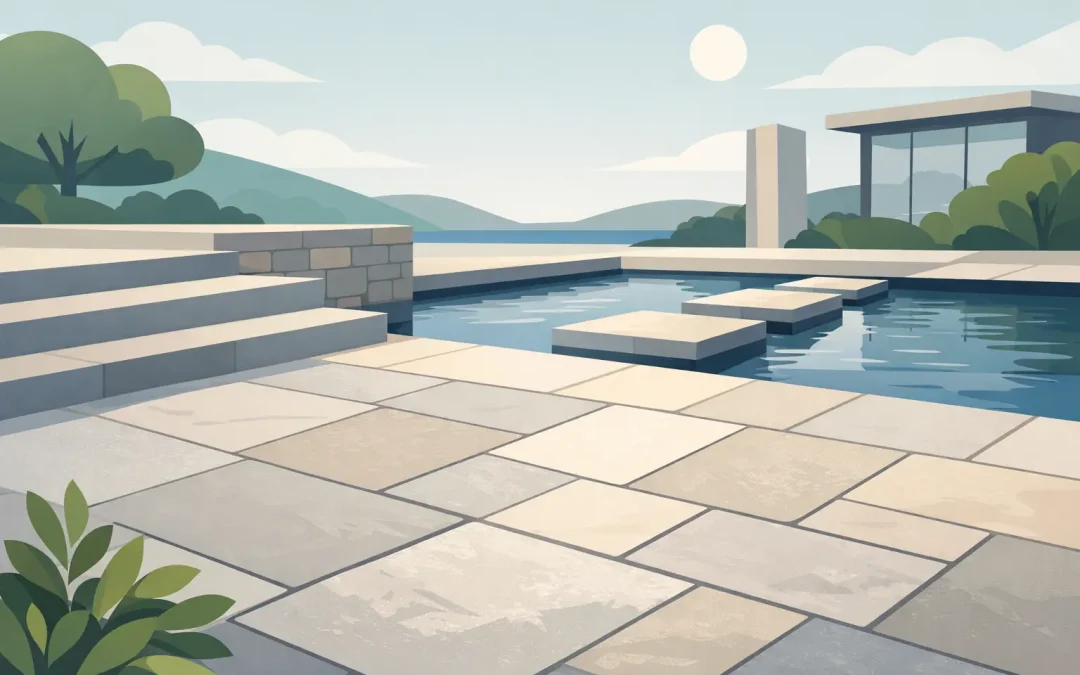
A terrace should not feel like a surface applied at the end of a project. It should carry the same architectural intent as the façade, thresholds and interior floors it connects. Stone paving offers that continuity: a materially honest plane with depth, tonal movement and a sense of permanence that manufactured finishes rarely achieve.
For ambitious residential, hospitality and civic work, Portland Stone brings an especially distinguished character to external spaces. This iconic British limestone has shaped some of Britain’s most recognisable architecture, including Buckingham Palace and St Paul’s Cathedral. In paving, its pale, composed palette can make a courtyard feel quieter, an entry more ceremonial and a garden connection more deliberate.
Why stone paving changes the reading of a place
Paving occupies a substantial visual field, particularly in low, horizontal architecture. It establishes the colour beneath glazing, furniture, planting and water, while setting the pace at which a person approaches a building. A natural limestone surface does more than fill this field. Its fossil detail, mineral variation and gently changing tones reward close viewing without competing with the wider composition.
Portland Stone is valued for this restraint. Rather than presenting a uniform, printed appearance, it carries authentic geological variation. The result is a surface that can sit comfortably beside crisp contemporary joinery, traditional masonry or richly planted landscapes. It has enough visual presence to anchor a project, yet does not overwhelm architecture designed around light, proportion and material clarity.
This quality is particularly valuable where exterior paving is visible from principal living spaces. When the same family of stone is considered across paving, cladding, tiling, steps or bespoke details, the transition between inside and outside becomes more resolved. Matching every surface is not the aim. A considered family of finishes, formats and tones usually produces a more convincing architectural relationship.
Stone paving begins with the setting
The right stone is not selected from a photograph alone. Aspect, climate, surrounding materials, intended use and the project’s maintenance expectations all influence the appropriate specification. A sheltered courtyard adjoining a refined interior may call for a different finish and format from a pool terrace, public entry or coastal garden path.
Pale limestone can be a strong choice in Australian light, where it helps temper heat gain visually and gives landscaped areas a luminous, settled character. Yet no natural stone should be treated as identical from one site to another. Pool surrounds and regularly wet areas require particular attention to finish, drainage and slip performance. Coastal locations call for a clear understanding of exposure, cleaning practices and the materials used around the paving.
The architect’s intended experience matters equally. Large-format paving can emphasise calm, generous proportions and reduce the visual interruption of joints. More compact formats can suit heritage-influenced settings, tighter courtyards or spaces that benefit from a more articulated rhythm. Straight laying patterns tend to reinforce formal geometry, while a more varied arrangement can soften the relationship between built form and planting.
Specifying Portland Stone paving with confidence
A successful stone specification balances appearance with the practical demands of fabrication, installation and long-term use. Portland Stone is available in a range of recognised beds and varieties, each with its own visual character. Basebed, Grove Whitbed, Jordans Whitbed, Roach and Stonehills Whitbed can differ in colour movement, shell content and texture, allowing project teams to select a material aligned to the architectural brief.
Roach, for example, is known for its open fossil features and can introduce a more expressive, textural reading. Whitbed varieties are often selected where a cleaner, more consistent limestone character is desired. The most suitable choice depends on the desired scale of variation, the required finish and the relationship to adjoining stonework. Samples should be assessed in the intended environment, not only under showroom lighting, because daylight and surrounding colours materially affect perception.
Thickness should be determined by the paving’s application and substrate design, rather than selected as a decorative afterthought. Pedestrian terraces, stairs, driveable areas and elevated systems each place different demands on the stone and its support. Joint design, falls, edge restraint and movement provisions also require early coordination. Water should be directed away from buildings and prevented from collecting at low points, where staining, surface contamination and avoidable deterioration can follow.
Finish deserves the same discipline. A finely finished surface may be appropriate for a protected setting, while a more textured finish can better answer the needs of exposed circulation routes. The required slip resistance should be assessed for the actual project condition, including whether the area is covered, regularly wet, steeply graded or subject to public use. There is no universal finish for every exterior application.
The importance of fabrication and laying
Even exceptional limestone can disappoint if its detailing and installation are treated casually. Paving should be set out with the stone’s natural variation in mind, so that tonal shifts and fossil markings feel intentional across the field. This is where dry-lay review, thoughtful blending of crates and careful placement of cuts at edges make a visible difference.
A narrow joint can create a precise, monolithic effect, but it also demands accurate fabrication and a well-prepared substrate. Slightly wider joints may be appropriate where movement, drainage or a more relaxed landscape character is part of the design. The jointing material should support the intended appearance while remaining suitable for exposure and maintenance requirements.
Thresholds, stair treads, drainage grates and transitions to other materials merit detailed drawings. These are the moments where a paving scheme either feels composed or reveals compromise. A well-resolved stone edge has visual weight. It can frame a planting bed, define a pool line or give an entrance a calm sense of arrival.
Patina is part of the material’s value
Natural stone is not a static product. Over time, it responds to weather, use and its landscape setting. Subtle mellowing and tonal change are often part of its appeal, particularly on projects intended to feel established rather than newly installed for only a season.
That does not mean maintenance can be ignored. Regular removal of leaf matter, soil and spills helps prevent surface marking, while suitable cleaning methods protect the limestone from harsh chemical attack. Acidic cleaners should not be used on calcareous stone. Any decision around sealing should be made for the specific application, with an understanding of how the treatment may affect appearance, breathability and future maintenance. A sealer is not a substitute for correct drainage, careful use or informed cleaning.
For high-value projects, it is wise to establish a simple care schedule at handover. This gives owners and facilities teams a practical basis for preserving the appearance of the paving without treating a natural material as if it were an inert synthetic finish.
A heritage material for contemporary Australian architecture
Portland Stone has endured because it offers more than historical association. Its value lies in the way it performs visually across time: pale but not flat, refined but not sterile, and capable of being cut into formats that support both classical and distinctly contemporary architecture.
Through its exclusive Australian supply relationship with Albion Stone, London Stone Co provides access to this multi-award-winning English quarry material for projects where provenance, finish quality and reliable technical knowledge matter. That access allows designers to specify a British limestone with a proven architectural lineage, while developing a response suited to Australian sites and ways of living.
The strongest paving schemes begin early, when stone can influence levels, thresholds, façade tones and landscape geometry rather than being asked to solve them later. Bring samples into the project, place them in the actual light, and let the stone guide decisions about scale, finish and detail. That is how an exterior surface becomes an enduring part of the architecture.
Recent Comments