
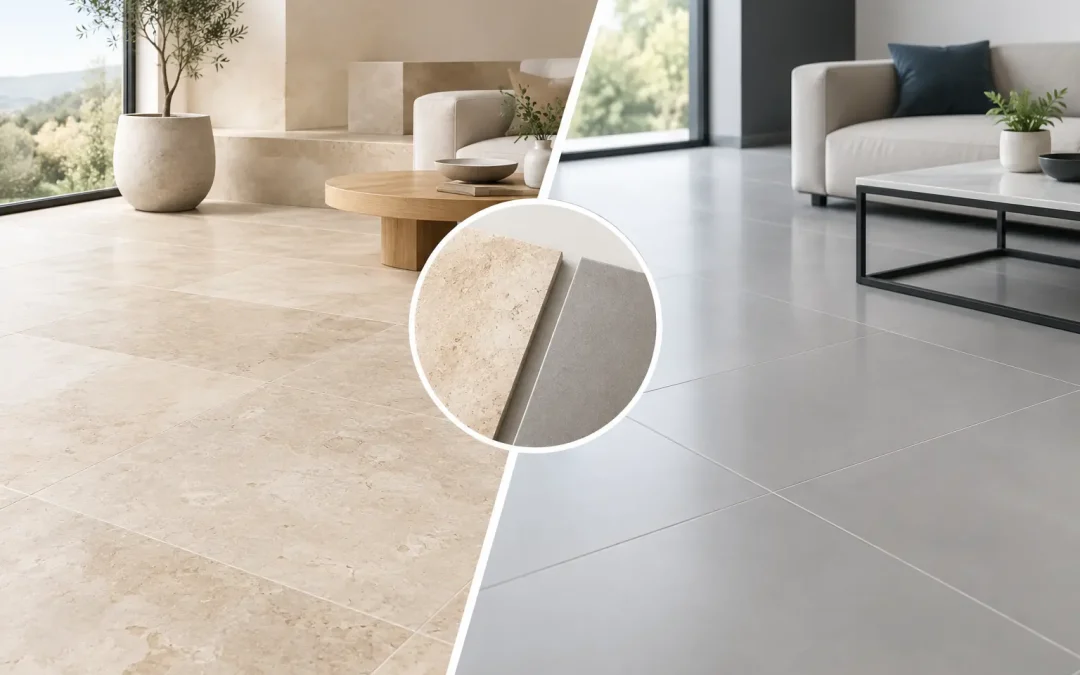
A material board can make limestone tiles versus ceramic appear to be a simple decision about colour, price or maintenance. On a completed floor, wall or terrace, the distinction is far more substantial. One is a geological material with natural variation, depth and a long architectural record; the other is an industrially produced surface designed for consistency and practical performance.
For ambitious residential, hospitality and commercial work, the right choice depends on what the architecture is asking the material to do. Is the surface intended to recede quietly, or to establish the character of the project? Will it run from interior rooms to an outdoor setting? Is the client commissioning a home to age with distinction, or seeking a highly controlled finish with minimal care requirements?
Limestone tiles versus ceramic: the essential difference
Limestone is a natural sedimentary stone. Its tonal movement, fossil traces, mineral markings and occasional open features were formed over geological time, not printed onto a surface. Every tile is part of a larger stone bed, and that continuity gives a floor or wall a visual depth that is difficult to replicate. Portland Stone, the iconic British limestone used in buildings including Buckingham Palace and St Paul’s Cathedral, is valued precisely for this quiet complexity and architectural permanence.
Ceramic tile is made by shaping and firing clay-based materials, often with a glazed or digitally printed face. Modern ceramic can convincingly imitate stone, timber and concrete, and it offers exceptional consistency in shade, format and surface pattern. That predictability can be valuable where a tightly uniform outcome is central to the brief.
The choice, therefore, is not between a good material and a bad one. It is between two different design languages. Limestone brings provenance and material individuality. Ceramic provides repeatability, broad decorative choice and a more forgiving routine of care.
Character is felt at room scale
A limestone sample may look restrained in isolation. Installed across a large entrance hall, living room or courtyard, its subtle shifts in tone begin to connect the entire composition. Honed surfaces can feel composed and contemporary, while more textured finishes bring a softer, more elemental quality underfoot. Veining, shell content and natural pores prevent the space from appearing mechanically repeated.
This matters especially in architecture built around daylight. Natural limestone changes gently through the day, taking on warm or cool notes as the light moves. It can complement timber, bronze, lime plaster and finely detailed joinery without competing for attention. A well-selected limestone floor also allows crafted elements, such as a stone hearth, stair detail or carved threshold, to feel integral rather than added later.
Ceramic has strengths of its own. It can deliver a very consistent pale ground across numerous rooms, provide strong graphic pattern, or reproduce a particular surface where budget and programme demand certainty. Yet even high-quality stone-look ceramic remains a representation of stone. At close range, and particularly at edges and through-body cuts, it does not carry the same inherent depth as a natural block quarried from a defined geological seam.
Variation should be specified, not treated as a defect
Natural variation needs informed expectation-setting. Limestone is not a manufactured product with identical faces. Project teams should review representative samples, understand the selected grade and agree the desired blend of tiles before installation. This is a design and procurement responsibility, not a compromise.
With premium stones such as Portland Stone, differences between Basebed, Grove Whitbed, Jordans Whitbed, Roach and other beds are part of the specification conversation. Their colour, shell content, density and visual character enable architects to choose stone that supports the intended atmosphere. Ceramic offers less uncertainty, but also fewer opportunities for this degree of material authorship.
Durability depends on location and detailing
Ceramic is generally hard, dense and highly resistant to stains and everyday scratching. Glazed ceramic is especially suited to busy internal walls, utility areas and projects where cleaning protocols must be simple and frequent. Porcelain, often grouped casually with ceramic in project discussions, is denser again and is commonly selected for demanding wet or external applications.
Limestone is durable, but it requires a more considered approach. A suitable stone selection, correct thickness, proper substrate preparation and a finish appropriate to the exposure are essential. In an entrance, kitchen, bathroom or pool-adjacent setting, the architect should consider water, drainage, slip resistance, traffic, cleaning products and the likelihood of acidic spills.
Acidic substances can etch calcareous stones, including limestone. Lemon juice, vinegar and some aggressive bathroom or masonry cleaners may mark the surface if left in contact. This does not make limestone unsuitable for kitchens or bathrooms; it means the material should be specified with realistic knowledge of use. A honed limestone floor in a family kitchen can acquire a gentle lived-in patina. Some clients consider that an advantage. Others will prefer the near-impervious practicality of ceramic.
External applications call for particular discipline. Tile finish, site drainage, expansion allowances, bedding method and local climate all influence long-term performance. In Australian conditions, heat, salt exposure and intense ultraviolet light may be more decisive than frost. Natural stone should be chosen and detailed for the exact setting rather than treated as a universal paving solution.
Maintenance is a question of expectations
Ceramic usually needs routine sweeping and cleaning with a suitable neutral detergent. Its low-absorption surface means spills are less likely to penetrate, and the regularity of the finish simplifies maintenance planning. Grout joints still need care, particularly in wet areas, but the tile face itself is uncomplicated.
Limestone benefits from sealing with an appropriate breathable stone sealer where the application requires it, followed by pH-neutral cleaning. Sealers reduce absorption rather than making stone invulnerable. They should be maintained according to the product and level of use. Abrasive pads, acidic cleaners and improvised household treatments should be avoided.
This distinction is worth framing correctly. Limestone does not demand constant attention; it demands respectful maintenance. Many of the world’s most enduring civic and ecclesiastical buildings demonstrate the longevity of natural stone when material, workmanship and care are aligned. Ceramic reduces risk where a project needs a highly resistant, low-intervention surface. Limestone rewards owners who value the evidence of genuine material over time.
Cost should be assessed beyond supply price
Ceramic commonly presents a lower initial material cost and may reduce installation complexity because tiles are consistent in thickness and calibration. It can also minimise wastage where a precise pattern repeat is required. For developer-led schemes or tightly budgeted renovations, those advantages can be decisive.
A premium limestone tile has a different value structure. Quarrying, selection, cutting, finishing, packing and international logistics are reflected in its price. Installation should be undertaken by experienced natural-stone trades, with allowance for dry laying, blending and careful cutting. This investment is visible in the completed architecture, not merely in a schedule of finishes.
Whole-of-life value also includes whether the material will remain credible as fashions move on. A natural stone floor can be cleaned, resealed, repaired and, in some cases, refinished. Its visual language is not dependent on a printed motif remaining current. Ceramic can perform admirably for decades, but a strongly trend-led imitation may date more quickly than an authentic, restrained stone.
Where each material is most convincing
Choose limestone when the brief values permanence, provenance and a sense of continuity between architecture, landscape and interior. It is particularly compelling in entry spaces, living areas, refined bathrooms, courtyards, terraces and hospitality settings where tactile quality is part of the guest experience. It also creates a coherent palette when paired with limestone cladding, paving, brickwork or bespoke carved elements.
Choose ceramic where the project needs strict visual uniformity, high stain resistance, simple upkeep or a decorative pattern that natural stone cannot provide. It is often the pragmatic solution for laundry rooms, secondary bathrooms, high-volume fit-outs and areas where the client does not want a surface that will develop patina.
There are also projects where both belong. Ceramic may be appropriate in concealed service zones, while limestone defines public rooms, principal bathrooms and exterior entertaining spaces. This is not a dilution of the design concept. It is material allocation guided by performance, budget and architectural importance.
For projects seeking the particular character of British limestone, London Stone Co provides exclusive Australian access to Portland Stone in tile, paving, cladding and bespoke formats. Early sample review and technical discussion allow the chosen bed, finish and format to be considered alongside light, detailing and intended use.
The most successful specification begins with the experience the building should offer ten years from now. Place the materials beside the timber, metalwork and paint samples, view them in changing natural light, and ask which surface will still make sense once the project has acquired a life of its own.
Recent Comments