
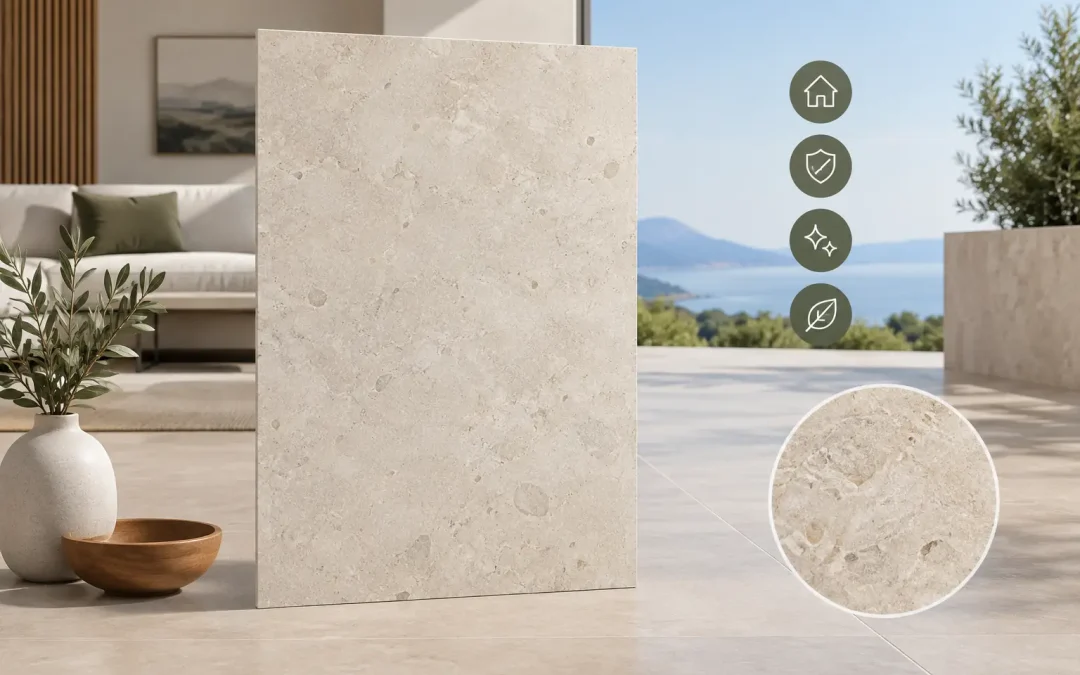
A useful Roach limestone review begins with what makes the material visibly different from other Portland Stone beds. Roach is not selected for a quiet, uniform surface. It is chosen for its open fossil structure, scattered shells and pronounced natural movement – qualities that give a façade, floor or carved feature immediate geological presence. For projects where authenticity matters as much as finish, it can be one of the most compelling stones in the Portland family.
What distinguishes Roach limestone?
Roach is an iconic British limestone quarried on the Isle of Portland in Dorset. It is recognisable by its fossilised shell content, including the characteristic hollows left where shells have weathered away. These cavities are a natural part of the stone, not a defect or manufacturing inconsistency. They create a surface with depth, shadow and variation that cannot be replicated convincingly by engineered alternatives.
The material sits within the wider Portland Stone tradition, a heritage associated with some of Britain’s most significant civic and cultural buildings, including St Paul’s Cathedral and Buckingham Palace. Yet Roach offers a more expressive interpretation of that heritage than the finer, more consistent Whitbed stones. Where Grove Whitbed or Jordans Whitbed may be specified for measured tonal continuity, Roach brings a more sculptural, fossil-rich character.
That distinction is central to successful specification. Roach rewards designers who want the building envelope or interior palette to carry visual interest through material itself, rather than through applied decoration. It is particularly effective where broad stone planes can be read from close range and changing daylight can reveal the relief of its shell beds.
Roach limestone review: appearance in a completed project
Samples are essential, but they tell only part of the story. A small Roach sample can look dramatically perforated, while a larger elevation reads as a balanced composition of pale limestone, fossils and subtle shadow. Equally, two pieces taken from the same bed will not present the same shell distribution. This is precisely its appeal, but it requires clients and project teams to accept variation as an inherent mark of natural stone.
The base colour is generally a light, warm neutral that works comfortably with restrained contemporary palettes as well as more traditional architectural language. It sits well beside bronzed metals, oak, dark joinery and hand-finished render. In coastal homes, hospitality settings and crafted landscape schemes, the stone can introduce a sense of permanence without appearing severe.
Roach is often strongest when used with discipline. It can command an entry wall, a fireplace surround, a substantial internal floor, a courtyard surface or a façade with deep reveals. Used across every surface of a compact room, its active texture may feel visually busy. The question is not whether the stone has enough character, but where that character will have the greatest architectural value.
Understanding the natural voids
The shell holes in Roach should be considered during the design stage, especially on finely detailed surfaces. Open voids can retain dust or moisture depending on orientation and application, and their irregularity affects the visual precision of sharp arrises, thin profiles and very fine joints. This does not preclude refined work. It simply means the detail should respect the material rather than demand a manufactured uniformity from it.
For certain interior applications, voids may be left open to retain the stone’s tactile quality. In other settings, particularly where a smoother cleanable surface is required, a suitable filling approach may be considered. The desired result should be established with approved samples and mock-ups, because filling changes both texture and visual contrast.
Performance depends on application and detailing
Portland Stone has a proven architectural legacy, but no limestone should be treated as interchangeable with another. The performance of Roach relies on the selected format, stone thickness, orientation, finish, fixing method and exposure conditions. A wall cladding panel, a paving unit and a carved mantel each place different demands on the material.
For exterior cladding, good water management is fundamental. Drips, copings, flashings, sensible joint design and carefully considered interfaces all help limit persistent saturation and staining. These principles are not unique to Roach, but its distinctive open texture makes thoughtful detailing particularly worthwhile. The façade should allow the stone to weather naturally rather than subject it to unnecessary water loading.
In paving, surface finish and location deserve equal attention. Roach can bring extraordinary texture to courtyards and terraces, though the chosen finish must be appropriate to expected foot traffic, cleaning practices and wet conditions. A polished finish may not suit an exposed threshold, while a more textured finish can better support practical use. Project-specific advice should always account for slip requirements, site drainage and the intended maintenance regime.
The stone’s pale tone is also an advantage in warm climates, where it can feel less heat-absorbing underfoot than darker materials. However, coastal salt exposure, freeze-thaw conditions where relevant, pool surrounds and heavily trafficked commercial settings each require their own technical review. Material provenance is valuable, but it does not replace proper design coordination.
Fabrication and format shape the final result
Roach’s design potential extends beyond slabs and standard tiles. It can be supplied for wall cladding, paving, flooring, steps, copings, ashlar, brickwork and bespoke carved components. The format should be selected alongside the stone bed direction and the visual scale of the architecture.
A large-format cladding panel allows the fossil pattern to read with fewer interruptions. Smaller units, by contrast, can produce a more textured and modular effect. Ashlar courses can reference classical Portland Stone façades, while sawn or split finishes shift the material towards a more contemporary, grounded expression. None is inherently superior. The right approach depends on whether the project calls for formal order, relaxed tactility or a deliberate contrast between old-world stone and modern geometry.
Bespoke elements are where Roach can become especially memorable. Deep window surrounds, carved signage, hearths, stair features and monolithic landscape pieces make use of the stone’s visual depth. At the same time, highly intricate carving may be more suitable in a finer Portland Stone bed where crisp ornamental detail is the priority. Roach is at its best when its fossil structure remains visible and legible.
Maintenance: preserve character, not artificial perfection
Roach limestone should be maintained with a light touch. Routine care generally centres on removing loose debris, avoiding harsh acidic cleaners and addressing spills promptly. Acidic products can etch calcareous stone, altering the finish and creating avoidable marks. Abrasive cleaning methods can similarly flatten the natural surface character that made Roach desirable in the first place.
Sealing is not a universal answer and should be assessed by application. In a food preparation area or a heavily used interior floor, an appropriate breathable treatment may assist with stain resistance. On an external façade, the priority is usually sound detailing and allowing the stone to behave as intended. Any proposed treatment should be trialled first, as it can affect colour, sheen and the appearance of shell voids.
A degree of patina is part of limestone’s appeal. Designers and owners seeking a perfectly unchanging finish may prefer a more uniform engineered surface. Those commissioning natural stone should expect the building to acquire subtle evidence of use and weather over time.
Is Roach the right Portland Stone for your scheme?
Roach is a strong choice when the brief calls for an iconic British limestone with evident fossils, texture and cultural weight. It offers a level of visual individuality that is difficult to achieve with quieter Portland Stone varieties, and it brings considerable value to architectural moments intended to be touched, approached and remembered.
It may be less suitable where complete visual consistency, ultra-fine detail or an uninterrupted smooth surface is essential. In those cases, Basebed, Grove Whitbed, Jordans Whitbed or Stonehills Whitbed may provide a more controlled result while retaining the enduring appeal of Portland Stone.
For ambitious residential, hospitality and civic work, the most reliable path is to review larger samples, confirm the intended finish and resolve technical details before stone is ordered. As the exclusive Australian supplier of Albion Stone Portland Stone, London Stone Co can support that conversation from early material selection through to project-focused supply. The best Roach schemes do not attempt to make the stone behave like something else; they give its fossil-rich character the space to become part of the architecture.
Recent Comments